

Why Review Volume Isn’t the Same as Review Cadence
If you’ve worked with review management services, then you’ve probably heard the pitch that they’ll help you get more reviews because that’s what you need. Which isn’t exactly wrong, but there is a but… Across roughly 13,000 multifamily communities in Opiniion’s data, the median property sits at 4.1 stars with 164 reviews. Most teams look at that benchmark and conclude they need a bigger number.
Now picture two properties, each with 164 reviews and a 4.1 average. The first has picked up a handful every month for three years. The second got 120 of them during a 2024 lease-up push and has heard almost nothing since.
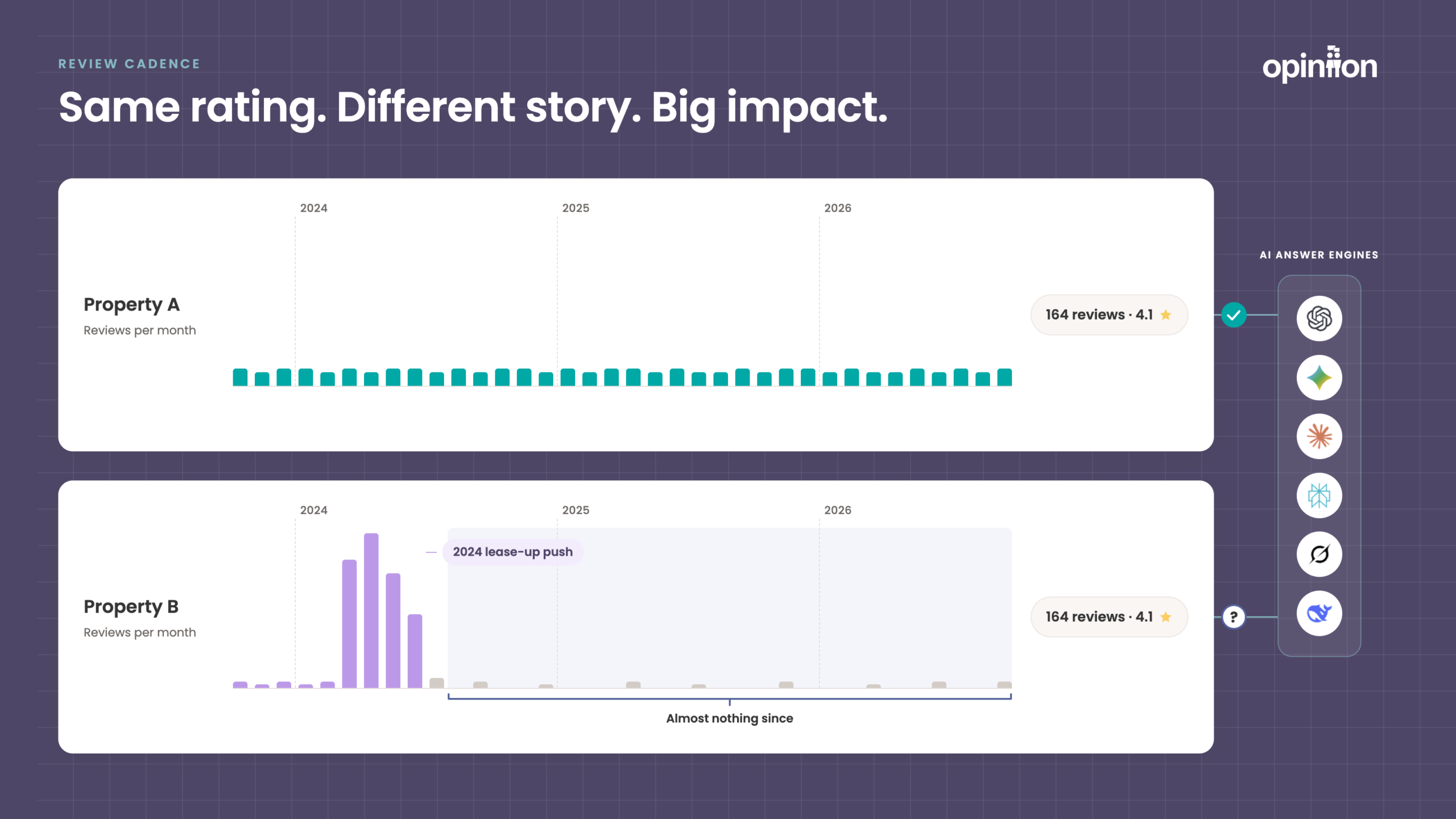
On a dashboard, they’re twins. To a renter asking ChatGPT “Is maintenance responsive at this place?”, they’re nothing alike. One property has current evidence. The other has history.
Wondering if AI is describing your communities from this quarter’s reviews, or from 2024’s? See what your renters see. Get a free AI Visibility Audit →
How AI Tools Read Your Review History
When a renter asks an AI tool for apartment recommendations, it doesn’t just pull your star rating. It looks for current, corroborated evidence of what living there is like right now. Teams experience turnover, maintenance gets better or sometimes worse, and policies change pretty often. A glowing review from three years ago can’t speak to any of that.
That’s why recency carries so much weight. A steady stream of feedback tells a model, and a renter, that the experience is being tested and confirmed month after month. A long gap leaves nothing to confirm.
The stakes are real even before AI enters the picture. Across 4.3 million tracked tour prospects, properties rated 4.0-4.4 stars generated 116% more tours per unit than properties under 3.0. You have to remember that your rating isn’t a vanity metric; it’s more of a demand lever, and it only works if the signal behind it is still alive.
The Scramble Pattern Most Dashboards Miss
Most properties don’t have a review problem. They have a review rhythm problem. Things go quiet for months, someone notices the rating slipping, and the team launches a push. Reviews spike and everyone exhales. Then right back to silence.
For a lot of teams, the frustrating part is asking, but unfortunately, it works.
Opiniion’s data shows that when properties actively solicit feedback during campaign months, both star ratings and the share of 4- and 5-star reviews go up. So the problem isn’t necessarily asking, but more so that most teams only ask when they’re already panicking.
Most review management services won’t flag this for you, because they’re built to report a number, not a pattern. That’s why we always tell our clients to see their review profile as more of a digital maintenance, kind of like the same way you wouldn’t service your HVAC only after it dies in August. Don’t treat your reputation that way either.
Review Management Best Practices for Building a Real Cadence
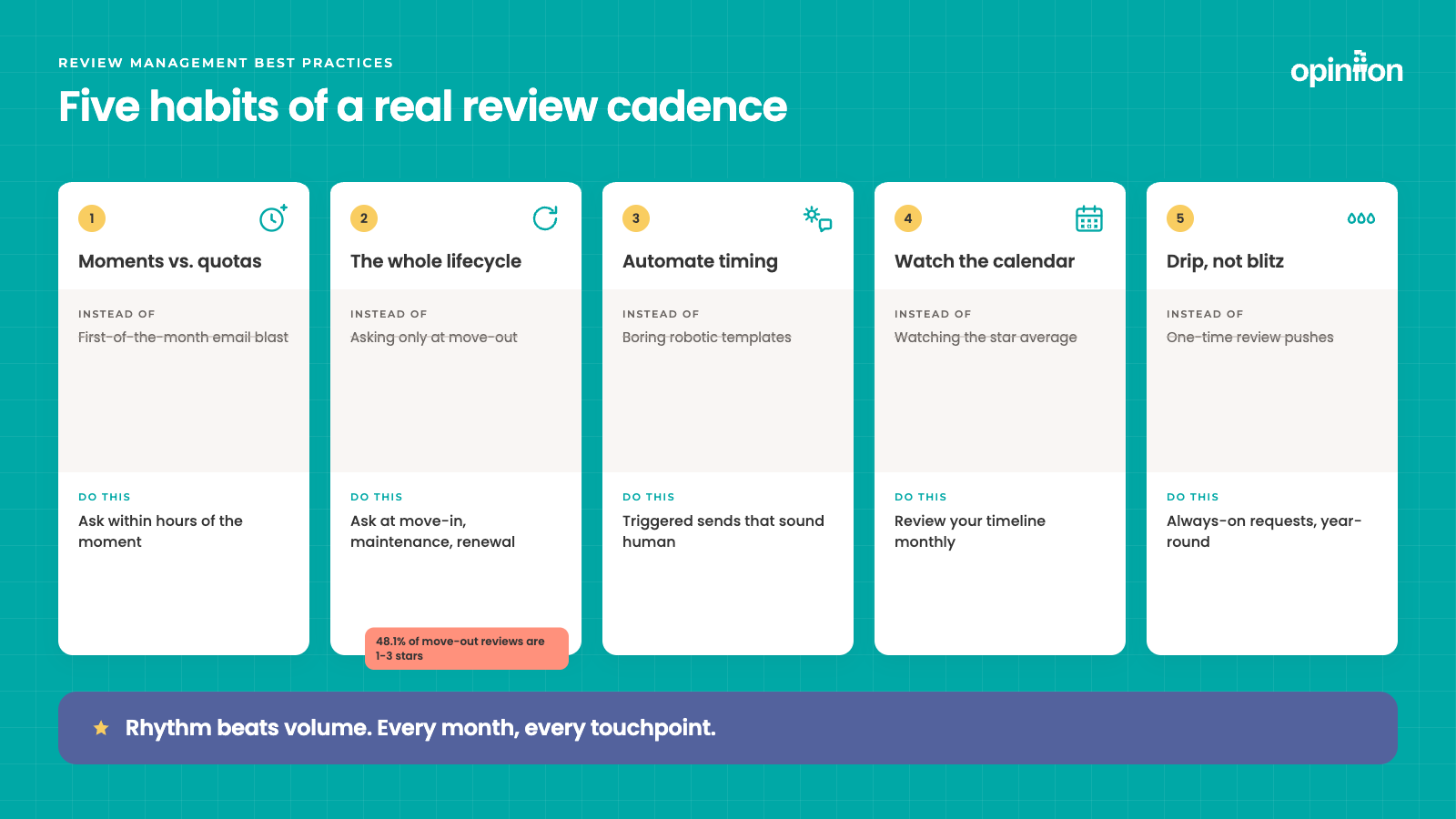
A few operating habits separate properties with a steady drip of reviews from the ones lurching between silence and scramble. None of them are complicated. All of them need someone who owns the calendar.
Tie requests to moments, not monthly quotas. A resident whose leak got fixed this morning is in a different headspace than one getting a cold email on the first of the month. Ask while the experience is fresh, because that’s when residents remember the details worth writing down.
Spread requests across the whole lifecycle. Move-out is the lowest-rated touchpoint we track: 48.1% of move-out reviews land at 1-3 stars, with an average of 3.29. If move-out is your only ask, your public profile will look worse than the life your residents actually live.
Automate the timing, not the tone. A trigger that fires two hours after a work order closes should still read like a person wrote it. Automation decides when. It should never decide what you sound like.
Track the calendar, not just the average. Once a month, look at your review history as a timeline. A dashboard that only shows your current star rating will never surface the 18-month gap sitting three scrolls down.
Don’t confuse a blitz with a strategy. A one-time push gets you a burst every time you pull the lever and silence in between, which is exactly the pattern that makes a profile look manufactured. If that push involves a giveaway, stop there: Google’s review policies prohibit incentivizing reviews, and the FTC’s fake-review rule adds real penalties when an incentive is tied to a positive one.
Executive Takeaway
Try not to think of your review profile as a quarterly scoreboard. Instead, think of it as digital maintenance. The question you should be asking isn’t “How many reviews do we have?” but more so, “When did we last get one, and from which part of the resident’s journey?”
Review Campaign Ideas Property Teams Can Run This Month
No new platform. No big budget. Just an owner for the calendar.
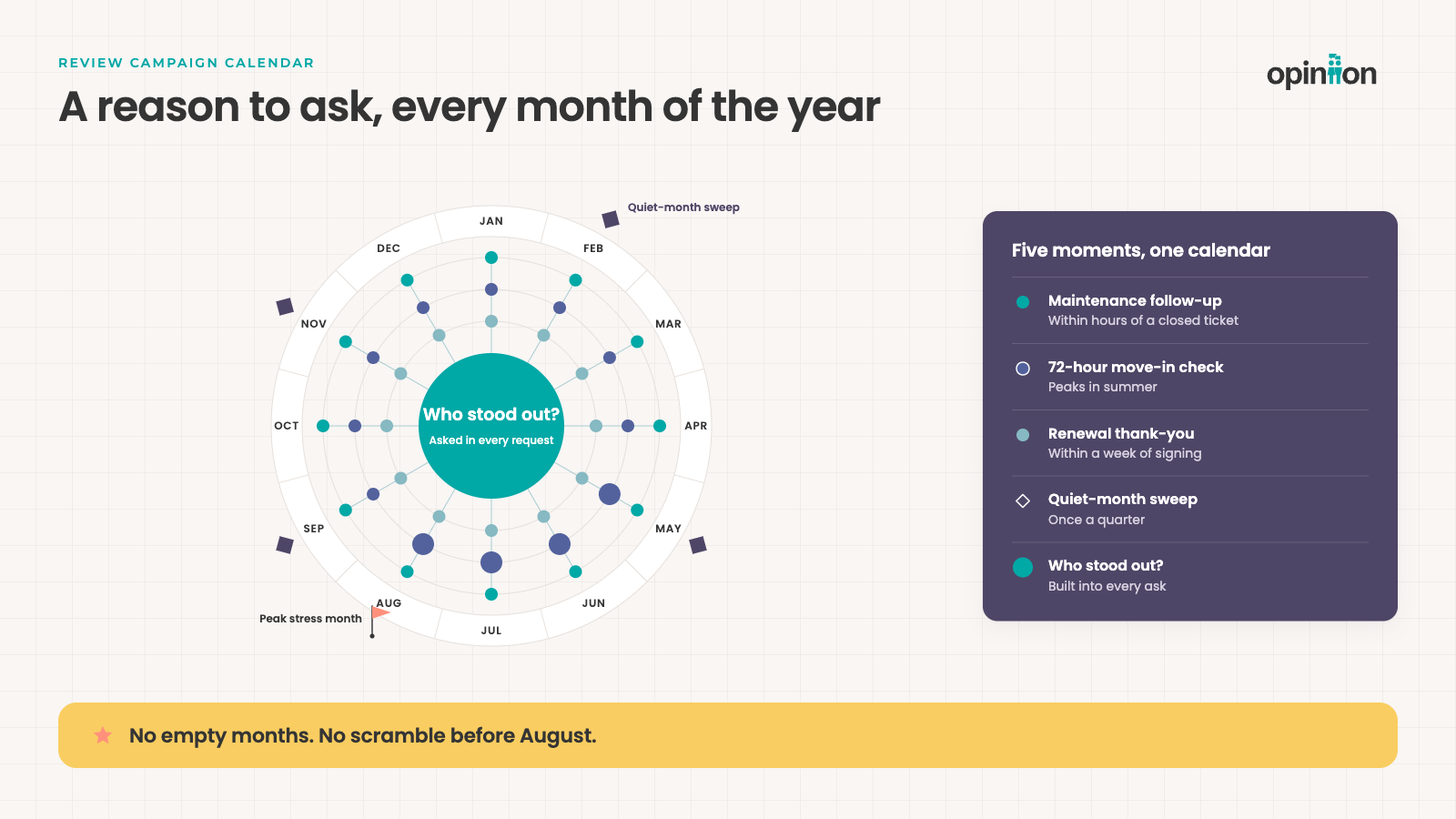
1. The 72-Hour Move-In Check.
Send a short request 72 hours after move-in; the window that our data shows sets the tone for the entire lease.
Ask one question: what surprised you, good or bad? Specific questions get specific answers, and specificity is what makes a review useful to a renter and to the AI model answering that renter’s question.
Fair warning: about one in five move-in reviews land at 1-3 stars, usually over broken items, cleanliness, or pests. That isn’t a reason to skip the ask. It’s the early warning you want now vs. at move-out.
2. The Same-Day Work Order Follow-Up.
Trigger a request within a few hours of a closed ticket, while the resident still remembers whether the tech showed up on time.
We’ve seen 42% of positive maintenance feedback mentions speed (quick, fast, prompt, same-day). That’s the exact language you want in your public reviews, because maintenance responsiveness is one of the top questions prospects ask before they ever tour.
3. The Renewal Thank-You.
Reach out within a week of a signed renewal. These residents just voted with their lease, so capture why while it’s fresh.
In negative renewal reviews, management and staff quality came up 2.7 times more often than rent increases. The other side of that is true too; people usually stay because of people, and that’s a story worth getting on the record.
4. The Quiet-Month Sweep.
Once a quarter, pull residents who haven’t had a move-in, work order, or renewal event in the last 90 days and send a simple “How’s it going?” It’s the easiest way to keep the drip alive through slow stretches.
Time one for late spring since August is the most stressful month across nearly every touchpoint (move-in ratings fall from 4.38 in the best month to 3.97), so you want a healthy, current body of reviews in place before the crunch hits.
5. The “Who Stood Out?” Prompt.
Add one line to every review request: did anyone on the team make a difference? Named details, like Ravi from maintenance or Jasmine in leasing, read as far more credible than a generic five stars, and they give AI tools evidence instead of adjectives.
Ask everyone, every single time. Sending only your happiest residents to public platforms is review gating. Google prohibits that, and it produces the too-perfect profile that nobody, human or model, fully trusts.
Not sure where your gaps are? Opiniion’s AI Visibility Audit shows how your communities appear across the major AI models, and where your review signal has gone quiet. Get a free AI Visibility Audit →
The Fix Isn’t More Reviews
Chasing volume alone is how properties end up in a cycle that does nothing, but works against you. And all you have to show for it is a stack of old reviews, followed by a long silence, and ending/starting with a rushed catch-up campaign. The properties renters and AI models trust aren’t always the ones with the most reviews. They’re the ones whose feedback never stopped coming in.
Most reputation dashboards can’t show you this, because they’re built to report a rating, but we’re built to identify the rhythm. Our analysis of nearly 14 million pieces of resident feedback across 13,000+ communities is how we know what a healthy cadence looks like for portfolios just like yours.
Cadence is half the trust equation. The other half is consistency across sources: what happens when your Google rating, your ILS listings, and your resident surveys start telling different stories? Just remember, AI is checking both.