Does Online Presence Management Affect AI Credibility?
When a renter asks ChatGPT or Gemini for apartment recommendations, its job isn’t to just retrieve a search; instead, it does the same due diligence as an apartment placement advisor, meaning it searches across as much “authentic” information as it can find to give searchers a full and honest picture.
Something our multifamily clients ask a lot is what does AI consider authentic? And for the most part, that’s going to be made up of multiple public, corroborated sources: listings, local data, and ,the big one… resident reviews. Yeah, that’s right, resident reviews are not usually at the top of general GEO playbooks to-do lists, but for our multifamily folks, of all the inputs, reviews are the densest, most trusted, and hardest-to-fake signal available, which is why AI trusts it so much.
Before AI, your property website was where all the focus was, but now it’s nothing more than a claim. You can say you have resort-style amenities and a responsive maintenance team, but do your reviews back it up? A coworker was just telling me a story about how her younger brother was viewing apartments for college, and she said when they pulled up to his first pick, he realized he had been catfished. My coworker asked him, “Did you even check the reviews?” Because she knew they would tell the REAL story, not a polished version of the truth, and AI feels the same way.
Traditional SEO reputation management controlled what ranked on page one. GEO shapes what AI models should believe to be true about your property; That belief is built from resident feedback, not from your meta tags. And it’s the reason we added AI Visibility to our platform, because we realized property managers are flying blind into a world where AI-driven recommendations (GEO) are replacing traditional search. You can’t optimize what you can’t see, and right now, you have no idea how these models are categorizing your brand, or even which competitors they’re recommending over you based on a few bad feedback loops.
We pull back the curtain in our demo and show you exactly how your properties are appearing across the major AI models. Our plan was and is to cut the fluff; we promise no “SEO best practices” from 2018, just raw data on where you’re winning and where the AI has decided you’re a “don’t recommend.” Worse case, you come out knowing a bit more about your online presence; best case, you start winning with our tool and become a top recommendation on all the most-used AI chatbots your renters are currently using!
Not All Review Profiles Send the Same Signal Opiniion has analyzed nearly 14 million pieces of resident feedback across the multifamily lifecycle.
That data shows that a strong review profile isn’t built on star rating alone.
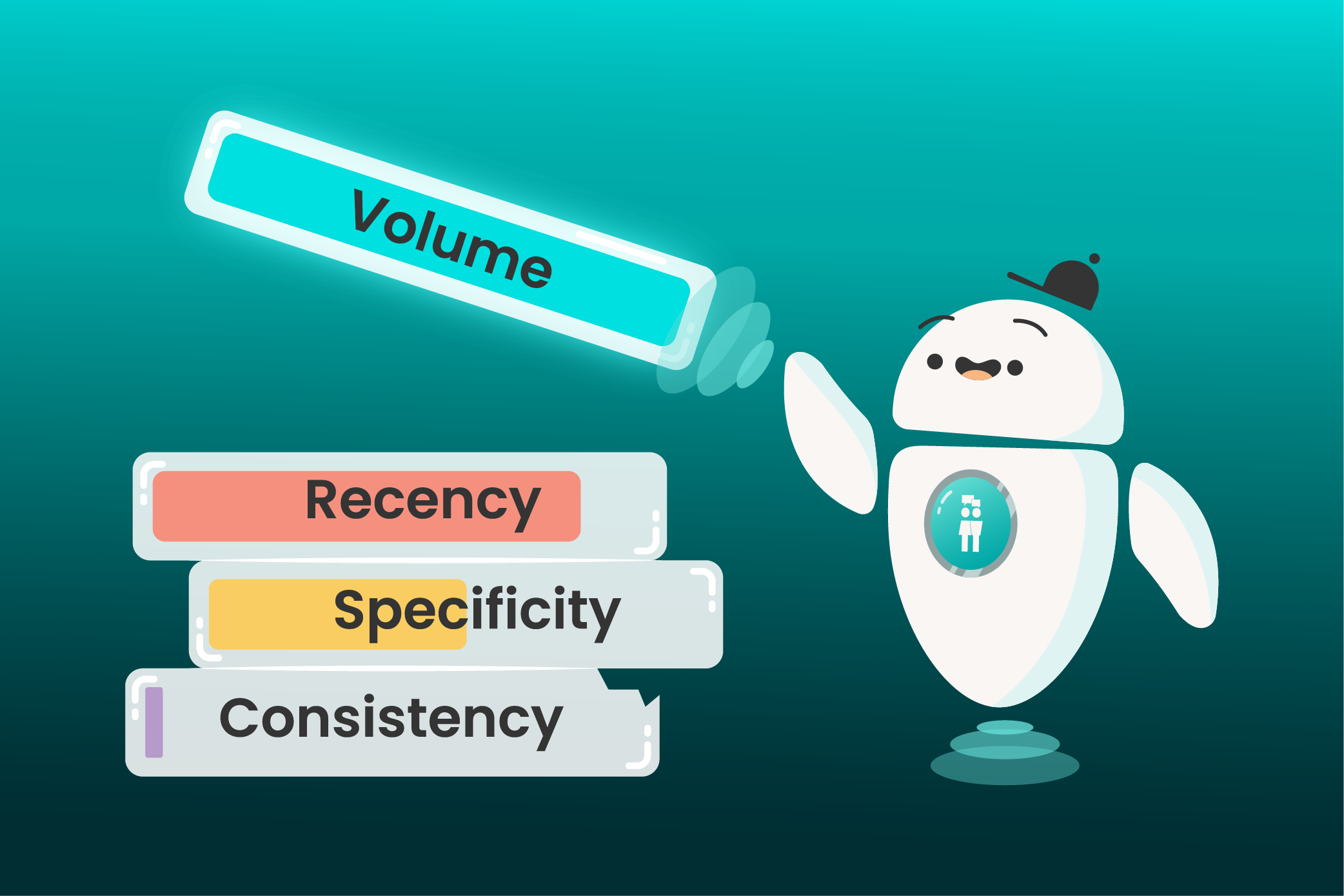
Four characteristics help determine whether your public reputation tells a credible and useful story:
- Volume
- Recency
- Specificity
- Consistency
Together, these signals give renters and AI systems more confidence in what they are seeing.
Volume
A handful of 5 star reviews may look impressive, but it doesn’t necessarily create a reliable picture of the resident experience.
The median property in our dataset carries a 4.1-star rating across 164 reviews, and that’s the baseline a model uses to decide whether you’re statistically trustworthy. A property with 12 reviews and a 4.8 average is not “better” to a model than one with 164 reviews at 4.1.
Volume matters because it makes sentiment more representative.
A larger sample helps show that the experience described in the reviews isn’t based on one unusually positive or negative interaction. It gives AI more information to compare and more evidence to use when answering renter questions.
That doesn’t mean every property needs thousands of reviews. It means a strong rating becomes more credible when it is supported by a meaningful body of resident feedback.
Recency
A strong collection of reviews from several years ago may not reflect what residents experience today.
Teams change. Maintenance performance improves or declines. Renovations happen. Policies shift. Communication practices evolve.
Recent reviews give AI a clearer view of current operations.
A stream of feedback this quarter beats a pile from 2022. AI doesn’t care for stale sentiment because it most likely won’t reflect current operations. A community that was great three years ago and then got quiet tells the AI nothing about what a renter would experience today. That’s why Multifamily reputation management is truly an operational discipline. So, don’t focus so much on the quantity as much as you do on whether they’re current and frequent.
The goal isn’t simply to accumulate as many reviews as possible. It’s to create a consistent flow of current feedback that reflects what is happening across the community today.
Specificity and Sentiment
“Great place to live” is nearly useless to AI. “Maintenance responded within 24 hours, parking has been fine, and the walls are thin, but the team’s pretty responsive” is worth its weight in gold. AI is answering the exact questions renters ask it, “Is maintenance responsive? Is it quiet? How’s parking?” and those are questions a property website can’t credibly answer about itself.
Specific reviews give AI more useful information because they describe the actual resident experience.
Your website can explain what you offer. Resident reviews can validate how well you deliver it.
The more concrete the feedback, the more useful it becomes when AI is trying to answer a renter’s exact question.

Consistancy
Do your Google reviews, your ILS listings, and your resident feedback tell the same story? Corroboration is what a model trusts. If your Google profile says 4.5 stars but your ILS reviews trend negative and your resident surveys show maintenance lag times, the model doesn’t average them out. It flags the inconsistency and discounts all of them. A coherent signal across sources is worth way more than a perfect score on one.
For example, imagine that your website emphasizes responsive maintenance and your Google reviews consistently praise fast service. Those sources reinforce one another.
But what happens when your website promises 24-hour maintenance while recent reviews repeatedly mention unanswered requests?
That inconsistency creates uncertainty.
AI doesn’t necessarily treat every source as equally reliable or combine them into a simple average. It looks for patterns and corroboration across the information available to it.
A coherent story across multiple sources is more credible than a perfect score on one platform surrounded by conflicting feedback elsewhere.
Why Reviews Outweigh Your Website
This truth alone is what keeps reputation management agencies in business: AI isn’t trusting your website as much as it is reviews.
Marketing teams spent years creating the perfectly polished property pages (say that three times fast 😂), because it worked. Now, while your website can answer questions about what you offer, it can’t answer questions about what it’s like to live there. And those are the questions renters are asking AI.
I looked up 10 random property sites across the country, and just about every single one said “24-hour maintenance.” Of those, only ONE had a review that said, “I’m so thankful for the 24-hour maintenance guy Ravi who came to open my door at 3 am after I lost my keys.” Reviews support the truth of what your website claims, and AI models know it. So, they weigh the input that can credibly answer the renter’s real question, and that input is your review profile.
Review management services are expensive, time-consuming, and in general, don’t give Multifamily stakeholders the full picture that’s needed to take action.
We noticed this huge gap between seo reputation management (pushing negative results down) and what operators actually need, which is a tool that can review signals across listings so consistently, currently, and specifically that an AI model has no reason to look anywhere else for the truth about your property.
What Opiniion’s Data Signals
Data gives us a full picture; luckily, we have a ton of it! In The Science of Five-Star Reviews, we found that the median multifamily property sits at 4.1 stars with 164 reviews. Anything below 3.5 stars lands in the bottom 17% of the market, which leads to a huge visibility problem. Properties in that group are the ones a model quietly excludes from recommendations because their signal is too stale or too negative to corroborate.
On the other side, our data also shows that when properties actively solicit feedback during campaign months, it leads to a lift in both star ratings and the share of 4- and 5-star reviews. In other words, volume stabilizes sentiment, which changes your signal from unreliable to stable.
Solid Signals are Manufactured, Not Lucky
Communities with the best signals are the ones that built a system to generate feedback across the entire resident lifecycle (move-in, after maintenance requests, at renewal, at move-out, etc.)
That’s what an AI visibility checker should do, but instead most of them just monitor what’s being said and leave it up to you to create the checklist. Opiniion’s AI Visibility tool is different from other AI reputation management tools for LLM responses; ours is deliberate when it comes to manufacturing signals. It’s easy to say you need volume and consistency, but those are outputs of a process, and you need something to uncover the inputs that’ll set you up for success.
In the end, the properties that win AI recommendations won’t be the ones with the best websites. They’ll be the ones whose residents are telling a consistent, specific story across every touchpoint. So, having reviews is important, but there’s way more to it if you want AI to trust you.