
AI Model Grading for Property Reviews
Most operators usually see AI visibility as a scoring issue. To them, it’s very straightforward: good reviews in and good recommendations out, but that’s not exactly how it works.
AI models aren’t really grading your property on a curve. Instead, they’re deciding exactly how much they trust the information they’re reading and finally deciding whether that trust is strong enough for them to make a recommendation.
And those are two totally different jobs. A property can have good enough sentiment and still end up with a shaky recommendation. That’s all because the AI model can’t really tell what’s currently true. That’s why confidence isn’t the same thing as a star rating. It’s really just the model’s read on whether your review profile is even usable.
See what your AI Visibility Audit would show before your competitor gets there first.
What Signals Should I Audit for?
At this point, we have thousands of SEO tools. Just take your pick, but for multifamily, that’s actually a huge problem.
All those generic SEO tools do way more harm than good because they were built to check meta tags, backlinks, and page speed, but what that doesn’t tell you is if ChatGPT trusts your Google profile enough to recommend your property over one three exits down the highway from you.
It’s early, but as we look at our customers, we’ve been seeing some pretty concerning patterns that are quietly eroding AI’s confidence even at their properties with solid star ratings.
Stale feedback
So many of our clients come excited because they have a ton of great reviews, but a lot of the time we have to deliver the bad news because a huge chunk of those are usually older reviews.
And while it looks great on paper, to AI, all it sees is a slow trickle of new feedback. Now it has no way to be sure that you’re as great as all those old reviews said you were.
AI tools can reason. They understand that teams change. A change in ownership early this year could mean that, all of a sudden, maintenance backlogs are stacked high, or there’s a bug problem now because the new company didn’t renew the pest control contract.
The point is, if there are no new reviews for AI to go off of, then it can’t confidently tell a renter what they would experience if they moved in this month.
Conflicting information
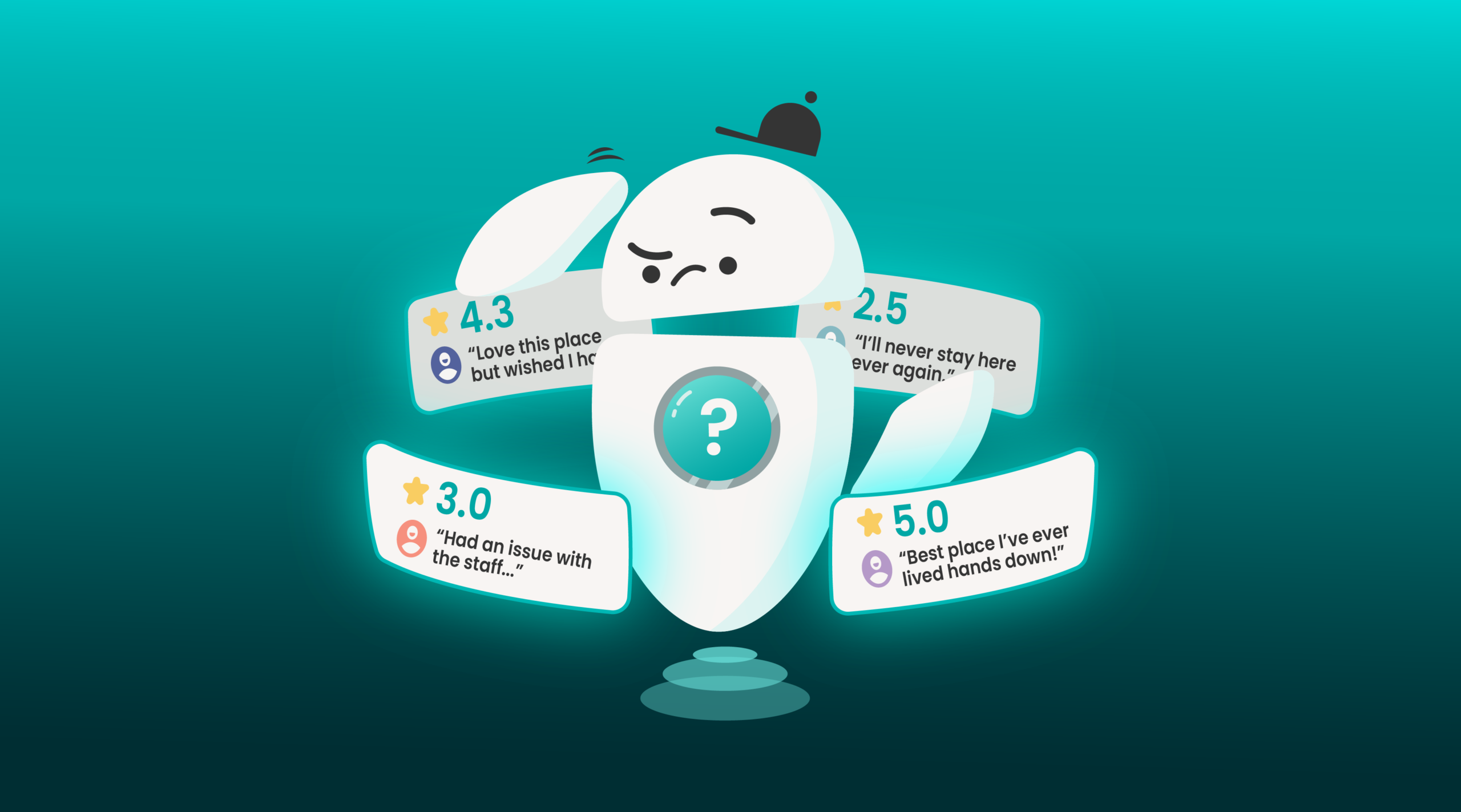
Look, we get it. You have so much information across so many different platforms that it’s hard to keep track of what you have said, let alone update all of that information appropriately. But unfortunately, AI doesn’t care.
You can have a website that promises 24-hour maintenance, and your ILS can brag about your resort-style pool. Then you’ve got a few Google reviews talking about slow work orders and a pool that’s been closed since spring for construction.
It’s confusing.
And an AI model isn’t going to take the time to average all those things out and land on a comfy middle-of-the-road recommendation. No, instead, it’s going to flag the mismatch.
Right, about now you might be thinking, “I’m sure that’s happening to tons of other properties too,” and sure, from our data, we can tell you it is. The problem is, once a model catches any property in a contradiction, it tends to discount everything else it finds there too, including all the good stuff, so now you’re just at the bottom with everyone else.
Generic or repetitive reviews
“It’s awesome here.”
“Susie was the best.”
“Safe place to live.”
I’m sure they’re not wrong, but they are pretty useless when an AI model is trying to answer a specific question for a renter.
You’ve got to understand that your renters want the most authentic, raw answers they can find. A close friend wouldn’t just say, “Yeah, a guy I knew said it’s nice.” No, a friend would say, “Oh, that place?! My sister lives there, and I find every excuse to go over and swim in their fancy pool. It’s ice cold in the summer!”
That’s what AI models are looking for.
Specificity goes a long way versus a wall of five-star reviews with exactly zero operational detail that gives nothing to cite.
Long gaps between reviews
This one’s kind of an echo of stale feedback.
We’ve all heard consistency is key, but here it really is. Profiles with clusters of two-year-old reviews that suddenly pause and then have another burst count as red flags to AI.
Either way, AI isn’t going to vouch for you.
A steady monthly drip is the way to go. Check out our blog on consistency and what you can do to get your renters reviewing you at a pace that won’t get you flagged, but will get you visibility.
Persistent negative themes
It’s true. One bad review isn’t going to tank your visibility. But if you get 10 reviews, multiple months running, all mentioning the same issues, those issues are exactly what AI models are built to figure out.
Don’t sweat a few isolated complaints here and there. It’s perfectly normal, and if anything, it’s healthy. It makes you look more real, more authentic, because realistically, not everyone’s going to love every single thing about every single one of your properties.
Now, when renters start leaving the same complaints about cleanliness or poor move-in condition, now you’ve got an issue because that tells a story, and AI’s reading it for bedtime.
Is GEO Worth Fixing?
Good news is nothing’s irredeemable.
Realistically, you could sit on your hands and make no changes, and your properties are not at risk of being permanently blacklisted.
All it really means is that AI models won’t have a ton of evidence to work with, and the less evidence they have, the less likely they are to recommend you.
Which, in a way, is pretty good news because that means a weak signal is fixable after all. Weak means something is still there, so it’s not like you’re building your reputation from scratch. It’s just a gap that you slowly need to close with a good cadence of current, specific, and cooperative feedback.
We studied a ton of properties, and the ones with the strongest AI visibility didn’t get there by accident. They purposefully built systems that generate feedback across the entire resident lifecycle.
Which means their signal never goes stale and never goes quiet because that feedback is coming from move-ins, maintenance requests, happy renter renewals, and eventually, move-outs.
Check Your AI Visibility
Any generic reputation dashboard will tell you your star rating, but it has absolutely no way of tracking the signals that matter to an AI model or how confused it might be with the information you have floating around out there.
We made a short list (no catch, we promise), run them against your own properties, and if you don’t know the answer most of our clients don’t, we can highly recommend doing an AI Visibility demo. Not only will you get personalized data, but you can take that data for free and make updates on your own!
- When was your last new review posted, and how many have come in this quarter?
- Do your website claims, ILS listings, and recent reviews all tell the same story?
- How many of your reviews mention a specific, checkable detail (parking, noise, maintenance speed) versus a generic compliment?
- Are there gaps of more than a few weeks between reviews at any point in the last year?
- Is there a topic that shows up in three or more negative reviews in the same quarter?
Note: After a demo, most people end up giving AI visibility a try because it’s one thing to see what’s missing, but it’s another thing entirely to figure out how to do it. AI visibility gives you a checklist but also tells you exactly what you need to do without any research, which ends up saving tons of time for your ops teams.
The Best Property Management Software
SEO reputation management software was built to help you figure out what’s going to rank on page one, but GEO is very different. It’s each AI model’s answer to what it should believe is true about your property at this moment.
Those are two totally different fights, and winning the first one won’t get you anywhere in the second.
AI Visibility tools give you a way to see through the eyes of your renters.
Create a sense of confidence that’s built from the freshness and specificity your story holds across every source a model scrapes the internet to find.
Get the clearest view of your AI visibility. Book a free audit and see exactly where the model’s confidence is running thin.