
If you’ve taken a GEO pitch in the last six months, you’ve probably heard the same checklist: add schema markup, build FAQ pages, clean up your location data, publish more content, and organize it into topic clusters. We’re not saying it’s bad advice, but it’s just not the full picture.
Which makes sense, because multifamily is kind of niche, but what doesn’t make sense is to take advice based on broad assumptions. Our data shows that the real question isn’t whether your website is easier for AI to understand, but whether your communities are visible and credible when renters ask AI tools for recommendations (and they’re definitely asking)!
At Opiniion, we’ve been studying this shift using one of the largest resident feedback datasets in multifamily. Our new AI Visibility Audit helps operators get a better understanding of how AI platforms perceive their communities, as well as what’s actually influencing whether they appear in AI-generated recommendations.
When a renter checks ChatGPT, Claude, Gemini, or Perplexity for “the best apartments in Austin with responsive maintenance”, the answer’s not built from your property page alone. Instead, it’s being shaped by public signals like Google reviews, ILS listings, resident feedback, recency, sentiment, and consistency across sources. That’s because renters are looking for the most raw and authentic ways to figure out if a community’s right for them, so naturally that’s what AI chatbots are offering their users. In Opiniion’s analysis of nearly 14 million pieces of resident feedback, properties with stronger Google ratings generated more tours per unit. Properties rated 4.0 to 4.4 stars generated 116% more tours per unit than properties under 3.0 stars.

When you’ve been in multifamily as long as we have, it’s no surprise that reputation moves leasing, but AI search has completely changed how that looks. So for multifamily specifically, GEO’s far from just a simple website optimization problem. It’s a reputation visibility problem, and most teams are solving the wrong one.
WRONG #1:
“Optimize your website, and you’ll show up.”
We have some of the best property management software out there, so we took it very seriously while researching and testing SEO vs. GEO for our new AI Visibility tool, and we found out the truth is, you’re just not going to be able to “schema” your way into GEO that differentiates you from your competitors. If you haven’t checked the basics (FAQs, content structure, etc.), then for sure do that, but if you’re trying to stay ahead of the curve, you have to go a step further. On-page optimization makes your content easier to understand and easier to reuse, which is half the battle. Now go a step further, and you’ll be out-thinking your competitors.
That next step is vital because once every property has polished its schema and published the same set of “pet policy” and “amenities” answers, the technical work stops being a differentiator. As AI changes, so does the benchmark, and leaders don’t do the bare minimum.
The bar has been raised, and our data shows renters are asking ChatGPT, Gemini, or Perplexity which apartments have responsive maintenance, quiet units, or reasonable parking; they’re not going to find that on your property page. They’re trying to understand what living there will actually feel like, and AI-generated answers pull from a changing mix of sources to give them a clear picture. And research on AI search shows that generative results can select sources differently than traditional organic rankings.Source: 2026 AI search study
For multifamily specifically, that’s a big deal! For our industry, most persuasive signals, like Google reviews, ILS listings, and local directories, live outside the website. So, we need the consistency of what people say across those places, and while a technically clean property site can help AI models understand what you claim, it doesn’t prove that it’s true.
WRONG #2:
“It’s ranking; visibility’s bound to carry over.”
SEO trained marketers tend to think in lists. Property’s Ranking? Check. Visibility? Check. Site Traffic? Check. No matter that your website is ranking seventh, visibility is middle of the pack, and you’re getting traffic, but is it even qualified?
That’s not to say SEOs are bad, but AI has completely flipped renter behavior and, subsequently, visibility. Before, renters were scrolling, comparing their options, opening a few tabs and making their own short list, and while some are still doing that, we’re moving quickly towards a new pattern where generative search compresses that behavior.
Instead of returning a page full of blue links, AI tools respond with a small set of named options and a short explanation of why those options fit the request. A renter may ask for apartments in a specific market with good schools and strong resident reviews, just to see two or three communities mentioned.
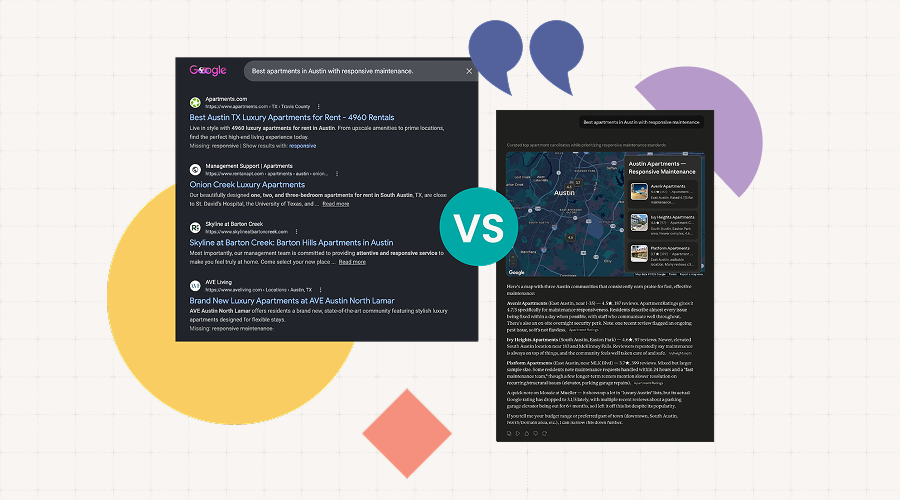
That changes the stakes. And hoping AI visibility will carry over from traditional search isn’t going to cut it. We’re at a point where ranking in traditional search won’t land you in an AI response.
That should make you uncomfortable. It exposes a risk, and from what we’ve seen so far, an unnecessary one. Especially when there are tools that can automatically feed you or your property managers the AI Visibility Playbook, without having to know the ins and outs of GEO.
WRONG #3:
“We can engineer our way in.”
With every thought leader in the industry tossing GEO around, debunking its myths, and giving you all the “hacks,” you’d think handing the problem over to an agency who “knows what they’re doing” would be the answer. You wouldn’t be alone; we were just talking with our sales and customer teams who were telling us how often they work with property management companies who’ve used an agency to amp up content production or tighten keyword research, hoping for AI exposure. But the fact is, you can’t engineer your way in.
We get it. It’s just easy to offload things we don’t fully understand and put your focus on something with better ROI, but your reputation IS your ROI. Hiring the best online reputation management company might help with processes and monitoring, but even the best vendor can’t mask weak resident experience if public feedback tells a different story.
AI systems are considering multiple sources. So, if your website says, “maintenance is responsive,” but recent reviews say “work orders go unanswered,” your website doesn’t get the final word. Your listings can say “every unit has solid gold chandeliers that were built by expert artisanal craftsman,” but if your resident feedback keeps mentioning move-in issues, the public record is the story that’s going to get told. That’s how GEO works. It’s why no matter how much you improve content quality, you’re still not guaranteed top response.
What’s even worse is reputation isn’t something most onsite teams can manually maintain every day, and really, they shouldn’t have to. Digital maintenance is for your property’s online reputation in the same way preventative maintenance keeps a building running smoothly. Continuous reputation management keeps the signals AI models rely on healthy over time, which is exactly what Opiniion automates.
We have the receipts on this. In The Science of Five-Star Reviews, we analyzed nearly 14 million pieces of resident feedback from across the multifamily lifecycle, drawing on years of experience helping multifamily operators manage their reputation. Across roughly 13,000 communities with Google data, the median property carried a 4.1-star rating and 164 reviews, and anything under 3.5 stars sat in the bottom 17% of the market.
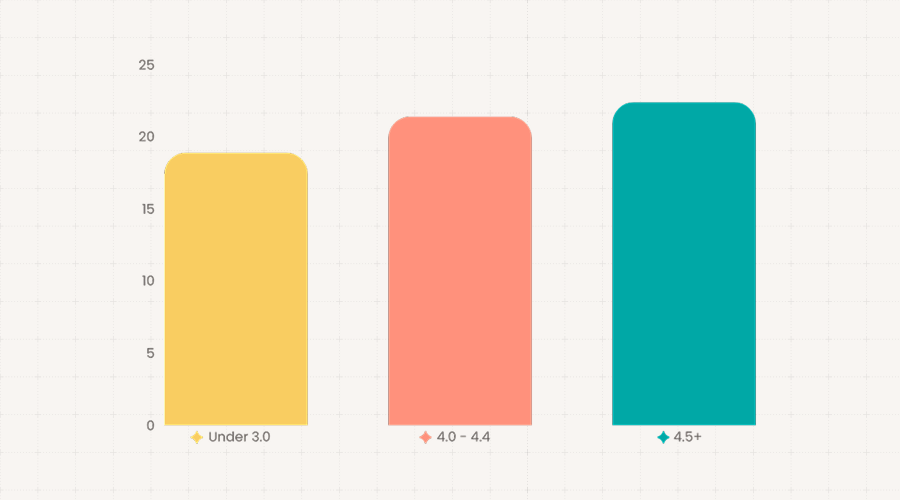
Then we looked at demand across 4.3 million tracked tour prospects at about 9,000 properties, which is where the 116% tour lift comes from. Stronger ratings didn’t just make properties look better. They pulled more prospects through the door!
The kicker? The questions those prospects asked were rarely about amenities. They centered on daily-life uncertainty, the kind of things you only learn from people who already live there.
Hard truth is GEO favors signals that cannot be manufactured in a sprint. The most durable advantage comes from resident experience that’s consistently captured, distributed, and reinforced over time, and that’s why reputation management SEO (really GEO) is so important
WRONG #4:
“We’re doing GEO, we just can’t see results yet.”
GEO measurement’s still early, but luckily search tools like Semrush are beginning to track AI visibility across prompts, platforms, and competitors, which is useful for benchmarking.
Unluckily… none of it’s specific to the multifamily property industry, and because of that disconnect, there’s a lack of results. The industry has known it’s an issue, but right now agencies hold all the power. A better question would be, “What if I could see results from within software tailored to my company?” And that’s completely doable by testing prompts renters might be asking AI tools for, like:
- “Best apartments in Austin with responsive maintenance.”
- “Apartments near downtown Raleigh with good parking and quiet units.”
- “Which apartment communities in Scottsdale have the strongest resident reviews?”
Then cross-reference what appears against your:
- Google reviews
- ILS listings
- local presence
- review recency
- resident sentiment
- competitor set
If that feels a bit overwhelming, yeah, we thought so too. That’s why it was important for us to release the latest in property management software news — AI Visibility. We wanted to put the power back in your hands, without all the tedious, specialist work that comes with it. You get a dashboard of customized reports for your targeted prompts, and a step-by-step action plan to improve overall AI visibility. It gives you a place to not just do GEO, but to see real results!
WRONG #5:
“Reputation is a support function.”
Historically, reviews were often treated as local ranking and conversion signals that helped properties look credible in search and gave renters confidence once a community made the short list.
AI search has moved reputation a lot further upstream.
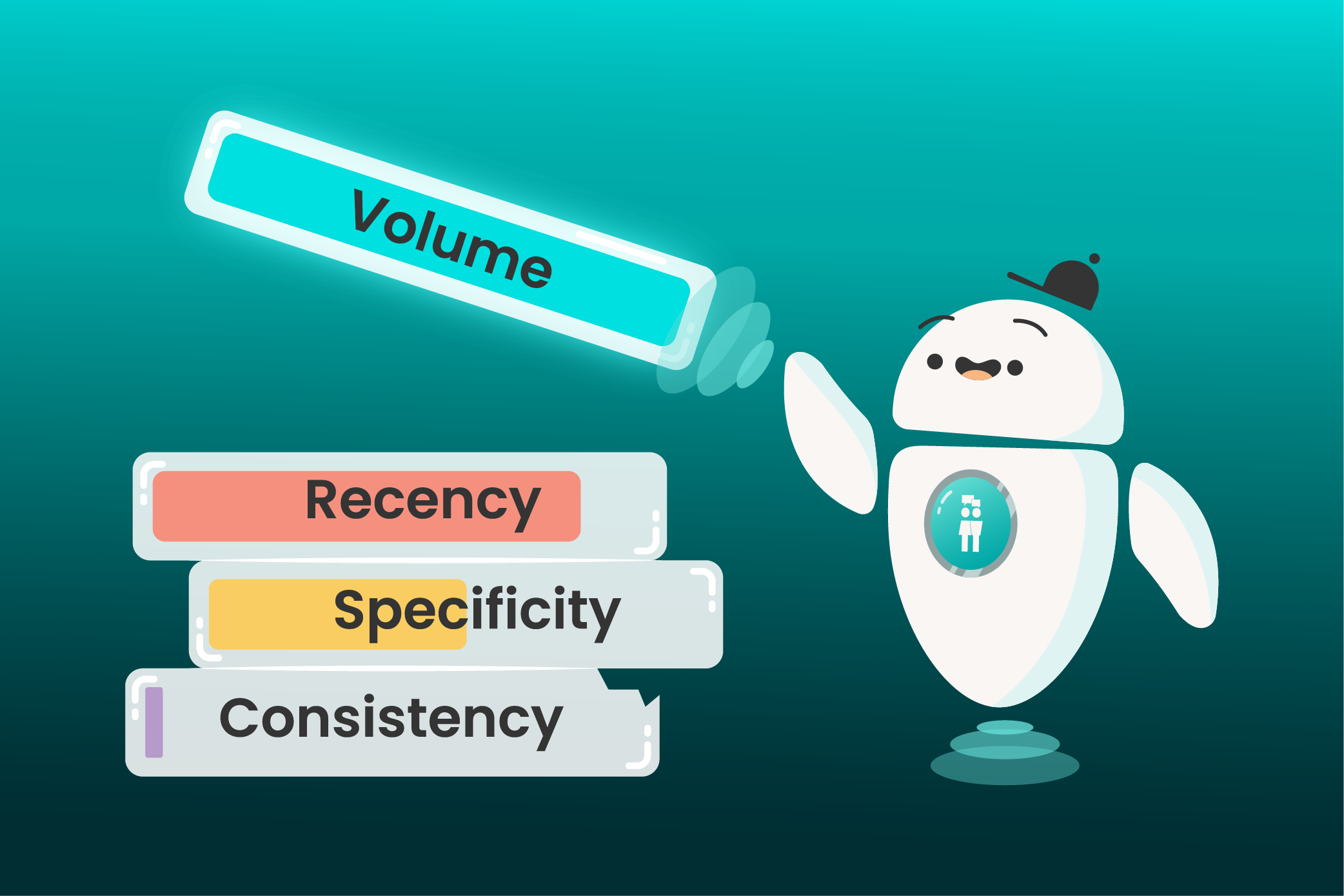
Now, AI tools are assembling the short list before many renters ever visit a property’s website. The volume, recency, specificity, and consistency of your resident feedback all influence whether your properties will be included in the first place. Meaning reviews are not just something renters check after they find you; instead, they’re quickly becoming part of whether renters discover you at all.
That’s why it’s detrimental for your reputation to be siloed as a support function when, in all actuality, it’s become a big part of distribution as a whole.
So What is GEO for Multifamily?
All this leads us to the big question, the one most multifamily teams have yet to answer:
How are my communities showing up when renters ask AI?
Everyone’s quick to speak on GEO readiness, but not many operators know if ChatGPT, Gemini, Claude, or Perplexity are recommending their communities, their competitors, or neither, and even fewer understand why.
That’s because AI isn’t just reading your website; it’s interpreting your public reputation.
Every review profile sends different signals, and the strongest ones are those that answer the questions AI models increasingly care about:
- Is the feedback recent?
- Are residents saying similar things across platforms?
- Are the details specific?
- Does the public experience match what the property claims?
- How does this community compare with competitors in the same market?
- Are unresolved issues showing up again and again?
All those have one thing in common: they’re hard to manufacture (no matter how much content you churn out). Schema, FAQs, etc. can help AI understand what you say about your property, but they don’t prove anything. And that might sound discouraging, but the good thing is it’s not out of your control.
Resident sentiment follows predictable patterns around friction, transitions, responsiveness, and how experiences end (i.e., quick move-in, fast work orders, or responsive staff). Moments where residents move out and leave a positive review vs. becoming a public detractor are moments that shape your reputation that AI will later summarize for your future renters.
As Devin, CEO of Opiniion, puts it:
“AI is changing how renters discover communities, but the fundamentals have not changed. Renters still want to know what it is actually like to live somewhere. The difference is that AI tools are now helping summarize that public reputation. For multifamily operators, that means reviews, resident sentiment, and consistency across the resident journey are becoming a visibility strategy, not just a reputation strategy.”
That’s the visibility gap most multifamily teams haven’t measured yet. SEO reputation management has been done, but AI property management software that helps operators close the gap between SEO and GEO is still in its infancy. We build AI Visibility Audit to shake that up.
- It shows where your communities appear across leading AI models.
- It identifies which sources are influencing those recommendations.
- It uncovers reputation and source gaps and provides a practical roadmap for improving visibility over time.
Early beta users are already finding that source-level visibility changes how they think about AI search.
“The source breakdown is incredibly useful. Being able to see where visibility is coming from, filter by authority, and turn those insights into a clear playbook makes the tool immediately actionable.”
— Beta Client
The first step isn’t another SEO/GEO checklist.
It’s understanding whether your communities are being found, trusted, and recommended in the places your renters are increasingly starting their search.